
Time is the most familiar and the most unresolved subject in human experience. We are born into it, measure it, fear its passing, and attempt to defeat it through memory, architecture, and art. Yet despite millennia of philosophy, science and creative practice devoted to understanding it, time remains stubbornly resistant to definition. We know how to read a clock. We do not know what a clock is reading.
Civilisations have risen and collapsed, stars have been born and extinguished, and through it all, one persistent human activity has been the attempt to mark, measure and make meaning out of time. We are part of a solar system located some 30,000 light-years from the galactic centre, within the Milky Way, one of an estimated 170 billion galaxies in the observable universe. The time we experience on Earth is almost certainly different from time elsewhere in the cosmos. It is relative, relational, warped by mass and velocity. Our linear, clock-driven model of time is a local habit, not a universal law.
And yet we have largely forgotten that. In a globalised digital age, time has been standardised, synchronised, and handed over to infrastructure. The ancient connection between human beings and cosmological time, the rhythms of the sun, the cycles of the moon, the turning of the stars, has grown faint. What we have gained in precision, we may have lost in meaning.
This essay traces a path through that lost connection: from the sun gods of ancient Egypt and Greece, through the philosophical foundations of ancient timekeeping, to four artists whose work makes time visible in radically different ways. It ends with a consideration of my own light installation, Cosmic Time Series, and the questions it attempts to hold in physical, luminous form.
The Greeks Had Three Words for Time
The ancient Greeks did not think of time as a single thing. They had three distinct concepts, each personified as a god.
Aion was eternity, the endless cyclical time of the cosmos represented as a young man enclosed within the zodiac wheel. He was a god of the ages, of what perpetually returns.
Chronos was the linear, sequential time we are most familiar with: the current that carries events from past to future, the time of clocks and calendars. Irreversible. Constant. As the philosopher Hippocrates observed, “Every kairos is a chronos, but not every chronos is a kairos.” Chronos was depicted in Greco-Roman mosaics as an old man with a thick grey beard, turning the zodiac wheel of Aion.
Kairos was something harder to define and, arguably, more important. It was the quality of time rather than its quantity: the right moment, the moment of opportunity, the instant when a decision becomes possible. Kairos “opens the time door,” a moment of choice and moral action. The wiser you become, the more clearly you can see kairos moments and act through them. In a world that has reduced time almost entirely to chronos, the concept of kairos has been nearly lost.
Together, these three gods positioned humanity within a temporal world that was layered, meaningful, and connected to the cosmos. That layering is worth recovering.
The Sun as Clock
Long before mechanical clocks, human civilisations organised time through their relationship with the sun. The ancient Egyptians tracked time through moon cycles, agricultural seasons and the positions of stars. Giant obelisks served as sundials, casting shadow markers across city squares. Portable gnomons aligned with the North Pole star allowed accurate readings of solar time. Star clocks, designed like wheels displaying the positions of constellations relative to the North Star, extended that reading into the dark hours of the night.
In Egypt, the sun was not merely a timekeeping instrument. It was a god. Ra, the sun deity, barred across the heavens during the day and descended into the dark underworld at night. That cycle of light and darkness was not a neutral astronomical event but a moral and cosmic one: the eternal battle between life-giving solar energy and the destructive forces of darkness. Ra was the father of all gods, the lord of the universe, the embodiment of divine order.
The temple of Abu Simbel in Aswan is perhaps the most astonishing physical demonstration of what this relationship between sun, time and power meant in practice. On exactly two days of each year, 22 October and 22 February, a beam of sunlight penetrates the temple’s narrow inner chamber and falls precisely on the face of the colossal statue of Ramses II. The alignment lasts some 20 to 25 minutes before the darkness returns. The rest of the year, the chamber is in complete shadow. This was not an accident. It was the result of extraordinary precision in mathematics, astronomy and architecture, calculated to demonstrate the pharaoh’s divine alignment with Ra. It is also, in a very real sense, a work of art about time.
The Egyptian understanding of time was structured around two gods: Osiris, associated with linear time that has a beginning and an end, and Neheh, representing cyclical time tied to the movement of the sun. Together, they formed a complete temporal picture that was simultaneously scientific and sacred. We have kept the science. We have largely discarded the sacred.
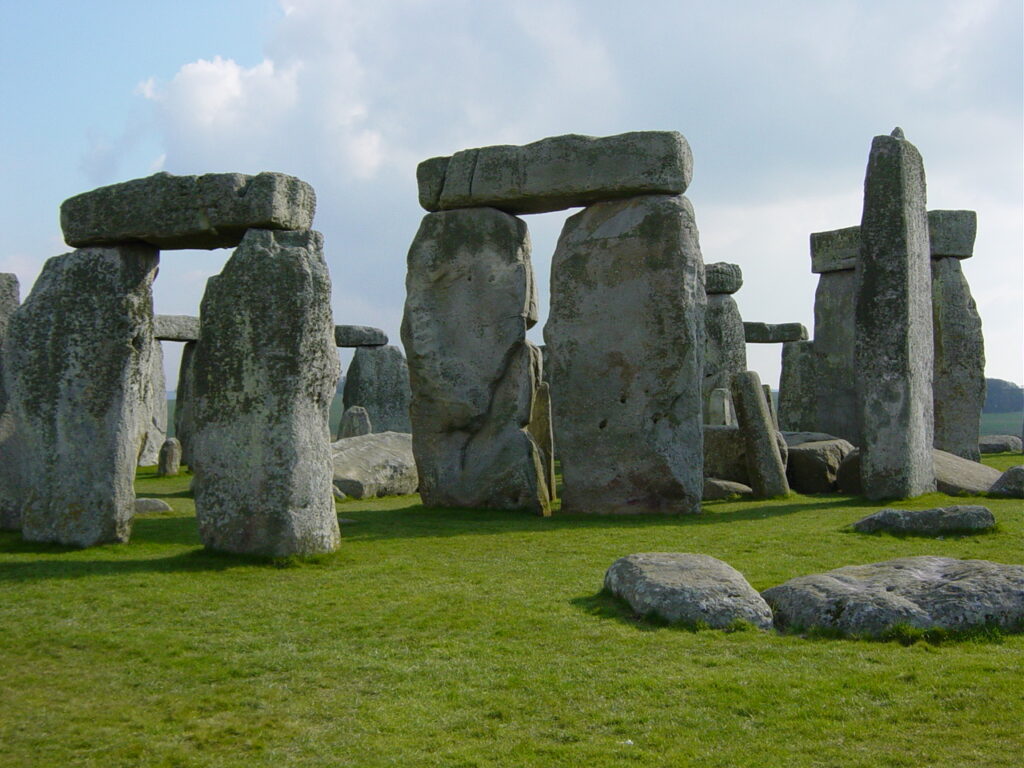
Stonehenge, thousands of miles to the north-west, represents a similar impulse. A stone monument aligned with the sun, positioned to mark the solstices, it gathered communities together to observe the turning of the year. People in the past were not merely measuring time. They were participating in it.
Space, Time and Light: Four Artists
Olafur Eliasson and the artificial sun
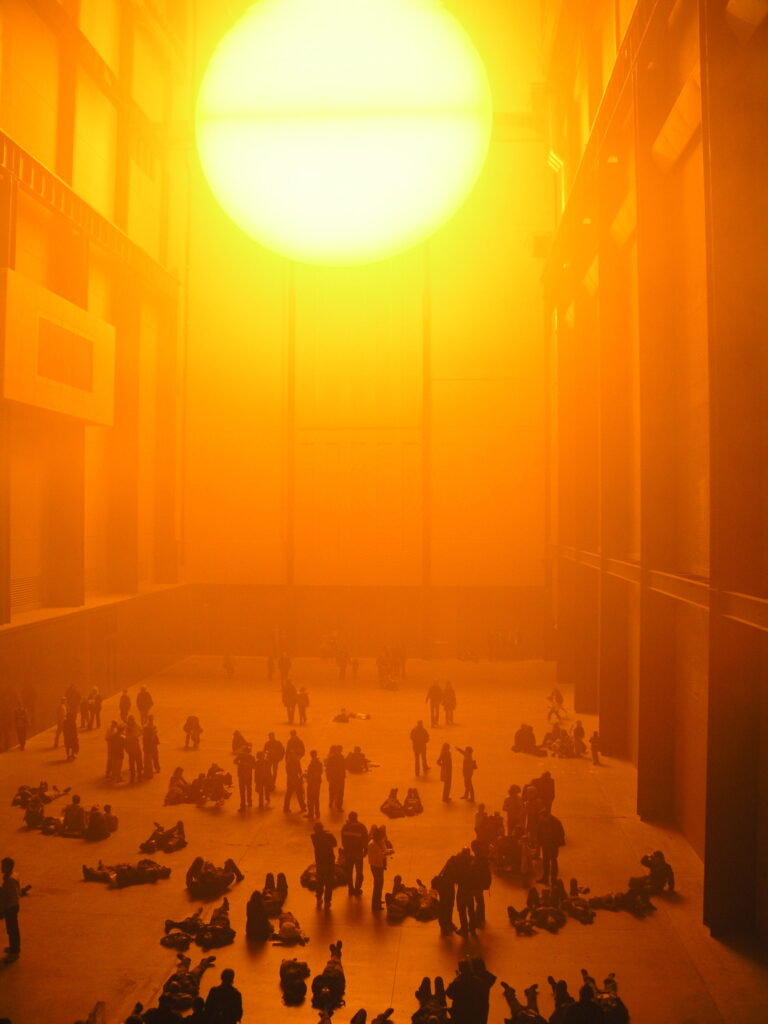
Olafur Eliasson’s The Weather Project at Tate Modern is one of the most significant large-scale light installations in recent decades. Filling the entire Turbine Hall with a semi-circular artificial sun set behind a fine mist, the installation created an illusion of the sun seen from within the clouds. Due to the mono-frequency low-sodium lamps used, only two colours were visible in the entire space: black and yellow. All other colours were absorbed. The ceiling was mirrored, making the semi-circle appear as a full sphere of light.
Visitors became silhouettes, tiny dark figures dwarfed by an artificial star. The scale made individual identity difficult to hold: you were no longer a person but a dot in the solar system. Eliasson, who was thinking about London weather and global warming as much as cosmic scale, made an observation that resonated beyond the installation itself: “You will see clouds today that you will never see again.”
Light is typically understood as a medium to illuminate objects. Eliasson treated it as an object of perception in its own right. In a space where time seemed to run at a different speed, where the familiar environment of a gallery disappeared into a disorienting orange cosmos, the work asked a simple question: what does it feel like to be this small, and to know it?
Salvador Dalí and the dissolution of measurement
There is a very strong connection between how we feel about time and how we hold memory. For that reason, surrealist painting offers a uniquely productive lens. Surrealism drew on Freud’s investigations of the subconscious to generate images from dream logic rather than rational planning. Unlike other surrealist artists who used automatic methods, Dalí crafted hyper-detailed dreamlike paintings that combined paranoid mental visions with precise, almost photographic technique.
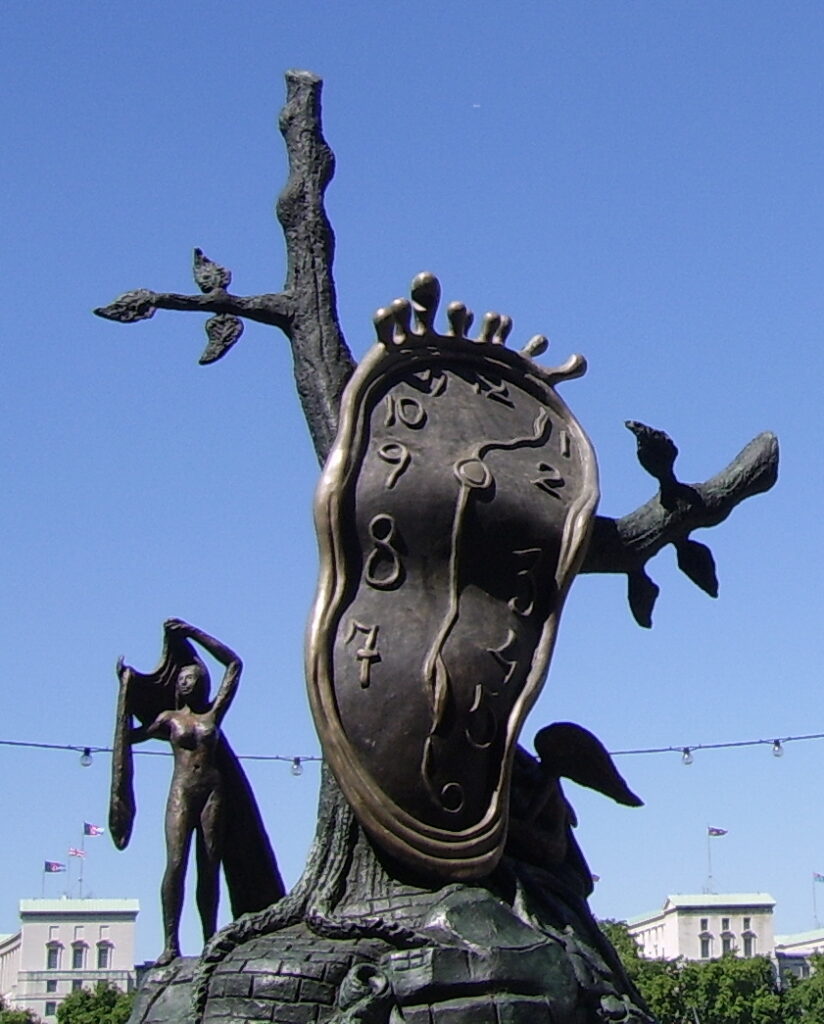
The Persistence of Memory (1931) is the most recognised image of time in the history of Western art. The melting clocks that drape themselves over surfaces and creatures have become synonymous with the idea that time is not the hard, mechanical, objective thing we assume it to be. The clocks are soft as cheese; Dalí’s own description was “the camembert of time.” They measure nothing. They are no longer instruments. The landscape is the coast of Catalonia; the creature beneath one of the watches is possibly a self-portrait. The ants devouring a gold watch suggest dissolution, the slow destruction of our instruments of measurement.
The painting articulates something that science had already begun to confirm in Dalí’s lifetime: that our sense of time’s passage is not fixed, not objective, not separable from the body and the mind that experience it. Time melts. Its apparent solidity is a kind of convenience, a shared agreement rather than a metaphysical fact.
Damien Hirst and time as process
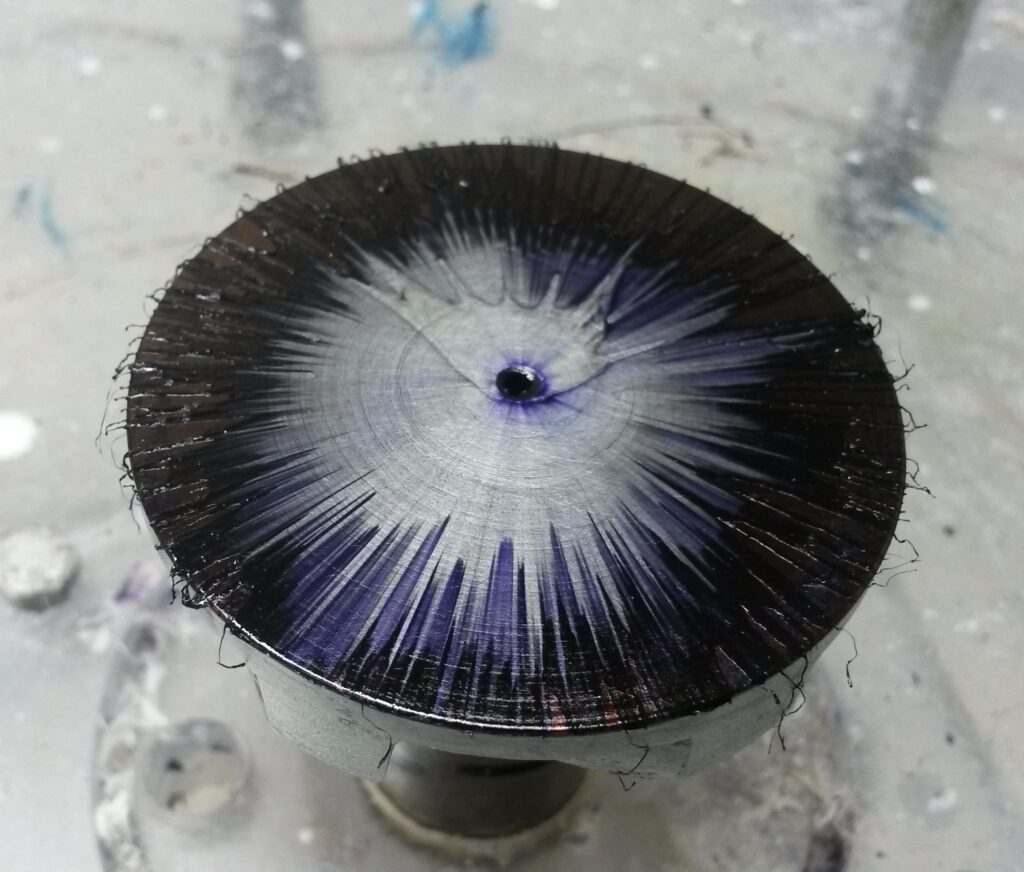
What happens when you remove intention from the making of a painting and replace it with physics? Damien Hirst’s spin paintings, begun in the early 1990s, offer one answer. Paint is applied to a rotating canvas. Centrifugal force does the rest. The result is determined by the speed of rotation, the timing of each colour application, and the viscosity of the paint. Each canvas is unique. None can be reproduced exactly.
The series title begins with “Beautiful” and ends with “painting.” Hirst described them as “childish in the positive sense of the word.” They are celebrations of movement, randomness and colour, made by time rather than about it. The rotation is a timekeeper; the canvas records what happened during a specific, unrepeatable interval. These artworks simulate time, movement and random accident, a time cycle that produces something new with each rotation.
They also raise questions about authorship, process and the status of the mechanical in contemporary art. The connection between artist and machine is essential, but not always comfortable. A simple idea that generates unique works through rotational movement, with no risk of duplication, raises the question: Who made this? The artist, or the process? Time, or Hirst?
Tatsuo Miyajima and the counter that never reaches zero
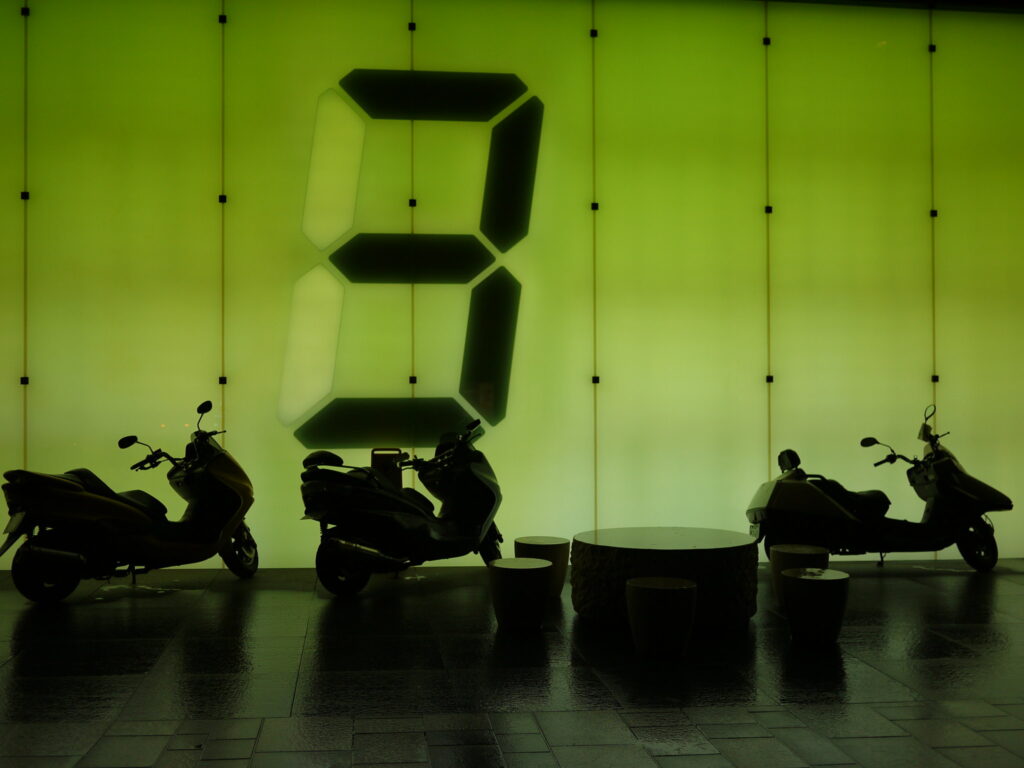
The Japanese artist Tatsuo Miyajima uses LED counters in nearly all of his work. Numbers cycle from 1 to 9, then skip directly back to 1. Zero is never displayed. Zero, for Miyajima, represents death, and death is not shown, only implied by the gap between 9 and 1. That gap is the dark moment, the pause before the next life begins.
“Time connects everything,” Miyajima has said. “I want people to think about the universe and the human spirit”. The counters move at different speeds. Some are fast, some glacially slow. Each counter represents a different human life, a different relationship to time. Together they form a glittering, multi-coloured grid, a web of individual existences within a larger whole.
Miyajima’s Buddhist influence is central to his practice. The LED counters perform the continuous cycling of existence: birth, change, death, re-birth. The 1-to-9 sequence mirrors the digital binary of modern technology (1 and 0, on and off) but refuses the zero state its finality. Technology and philosophy are held in the same object, as are light and darkness, speed and stillness, the individual and the universe.
The colours matter too. Early in Miyajima’s career, only red and green LEDs were commercially available. As technology expanded, blue and white appeared, opening connections to the sky, the universe and the white lotus of Buddhist symbolism. The work grew with its materials. Time, in Miyajima’s installations, is not a measurement but a relationship.
From the Brain Outward
Science has been catching up with what art has long intuited. Albert Einstein’s theory of relativity demonstrated that time is not fixed: it moves more slowly in strong gravitational fields and at high velocities. An object moving fast experiences time moving slowly relative to a stationary observer. The Newtonian model of absolute, universal time was not wrong so much as local, applicable within the limited range of speeds and scales that humans inhabit.
The brain’s experience of time is equally non-absolute. Psychologists have established that memory is not a recording but a reconstruction: every time we access a memory, we change it slightly to accommodate new information. The past we carry is an edited version of what happened. Furthermore, the brain processes used to think about the future are closely related to those used to recall the past. Imagining tomorrow uses the same neural architecture as remembering yesterday. Without autobiographical memory, we would have no future to imagine.
Time also feels different at different velocities of life. Dense, pressured periods slow time down through the accumulation of distinct memories. Happy, flowing periods feel fast precisely because they are absorbed without friction, recorded as one continuous texture rather than individual events. To slow time down and make it feel longer in retrospect, the research suggests, one must seek new experiences and new contexts. The brain records novelty. It compresses familiarity.
What we understand as “the present” is, neurologically, always slightly delayed. Sensory processing takes time. The experience of now is the experience of a very recent past. As Aristotle recognised, the present is something continually changing, a river of passing events that we can never quite step into twice. The cosmological dimension of this is vertiginous: when we observe distant stars, we are seeing light that left those stars thousands or millions of years ago. We are looking at the past. The universe we observe is the universe as it was, not as it is. What we call the present is, on a cosmic scale, always already history.
Cosmic Time Series: Making the Question Visible
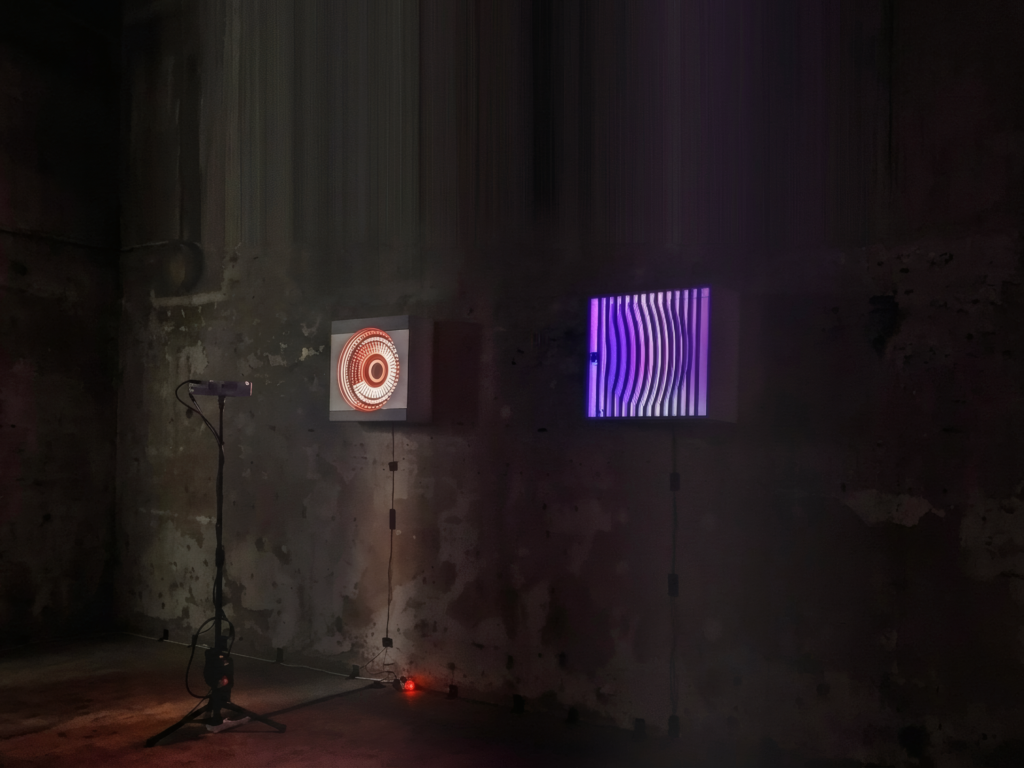
All of the ideas discussed in this essay converged, for me, in the making of Cosmic Time Series, a two-object light installation first exhibited in 2022.
The installation approaches time from two angles that directly mirror the philosophical oppositions running through this essay: time as measurement and time as experience, chronos and kairos, the clock and the body.
Object 1, Time is… Time is not… is a wall-mounted light sculpture that functions as a clock while simultaneously undermining the authority of the clock. Custom generative software written in C++ projects the accurate time onto the object’s surface, but cycles continuously through philosophical propositions about time’s nature. Every minute, a new question. Every minute, a different answer. The time is always correct. The meaning is always open.
Object 2, Time is an illusion, removes the clock entirely. There is no chronological display. Instead, the object responds to the viewer’s presence: activating specific light-changing patterns depending on their distance from the work. Move closer, and the light shifts. Step back, and it changes again. Duration becomes genuinely uncertain. Five minutes may pass, or one. The work does not say.
Together, the two objects stage a proposition that this essay has been tracing: that time is simultaneously the most measurable and the least measurable aspect of existence. It can be read on a clock face and dissolved in an instant of presence. It can be tracked to the millisecond and yet remain, in Einstein’s phrase, “a stubbornly persistent illusion”.
The installation has been exhibited at Bargehouse, Oxo Tower Wharf (2022) and St. James’ Hatcham Church, London SE14 (2023). As the artists discussed here, it does not attempt to resolve the question of time. It attempts to make the question visible and beautiful.
Time is a multi-perceptional and personal experience in constant motion. It can be divided and measured, recalled and distorted, anticipated and mourned. It connects the human body to the cosmos and the cosmos to the human body, though we have largely forgotten that connection in an age of globalised, synchronised digital time.
What art can do, what Eliasson’s artificial sun, Dalí’s melting clocks, Hirst’s spinning canvases and Miyajima’s cycling counters all demonstrate, is recover that connection experientially. Art does not explain time. It places the viewer inside a particular relationship with time and asks them to feel it rather than read it.
Ancient civilisations knew this. The temple of Abu Simbel was not merely architecture. Stonehenge was not merely a calendar. They were instruments for placing the human being inside a larger temporal order, for making cosmic scale perceptible within a human body standing in a specific place at a specific moment.
We are still doing this. The tools have changed: LEDs rather than stone, projection software rather than shadow clocks. But the question is the same. What is time? How do we live inside it well? And how do we remember, in the rush of chronos, to wait for kairos?
References
- Einstein, A. (2006) Relativity: The Special and General Theory. Penguin Publishing Group.
- Groom, A. (2013) Time. London/Cambridge, Mass.: Whitechapel Gallery; MIT Press.
- Hammond, C. (2019) What we get wrong about time. BBC Future.
- Hirst, D. (2012) Spin paintings.
- Kamrin, J. (2017) Telling Time in Ancient Egypt. In Heilbrunn Timeline of Art History. New York: The Metropolitan Museum of Art.
- Kim, S. (2017) Toward a Phenomenology of Time in Ancient Greek Art. In The Construction of Time in Antiquity: Ritual, Art, and Identity, pp. 142–172. Cambridge University Press.
- Lisson Gallery (2021) Tatsuo Miyajima.
- Mark, J. (2021) Ra (Egyptian God). World History Encyclopedia.
- MoMA (2019) Highlights: 375 Works from The Museum.
- Miyajima, T. et al. (2016) Tatsuo Miyajima. Museum of Contemporary Art Australia.
- Pannenberg, W. (2005) Eternity, Time, and Space. Zygon, 40(1), pp. 97–106.
- PublicDelivery (2021) Olafur Eliasson: The Weather Project.
- Watterson, B. (2003) Gods of Ancient Egypt. The History Press Ltd.
- White, E.C. (1987) Kaironomia: On the Will-To-Invent. Cornell University Press.
- Yordanov, H. (2022) Cosmic Time Series. Light installation.
Image credits
- pic. 1 – Stonehenge Closeup. Public Domain. Source: Wikimedia Commons
- pic. 2 – Olafur Eliasson, The Weather Project. Photo: Istvan, CC BY-NC-ND 2.0. Source: Flickr
- pic. 3 – Salvador Dalí, The Nobility of Time. Bronze sculpture. Source: Wikimedia Commons, CC BY-SA
- pic. 4 – Centrifugal painting, The Big Bang Theory. Photo: Ms.Headly, CC BY 4.0. Source: Wikimedia Commons
- pic. 5 – Tatsuo Miyajima LED installation. Photo: shibainu, CC BY 2.0. Source: Flickr
- pic. 6 – Cosmic Time Series.
